Geopolitical Disruption to the Semiconductor Industry Ecosystem
Geopolitical Disruption to the Semiconductor Industry Ecosystem
- Source: SemiVision
- Author: SEMIVISION
- Published: 2025-03-24T23:23:15+08:00
- URL: https://tspasemiconductor.substack.com/p/vip-report-mar-2025-geopolitical (1) Geopolitical Disruption to the Semiconductor Industry Ecosystem


Geopolitical Disruption to the Semiconductor Industry Ecosystem
Original Article by SemiVision Research

Mar 24, 2025
∙ Paid
Thank you to all our VIP members! We will be providing you with exclusive content and insights every month.
Geopolitical Disruption to the Semiconductor Industry Ecosystem
Introduction: Semiconductors in Modern Geopolitics
Semiconductors – the tiny chips powering everything from smartphones to missiles – have become central to global power struggles. They enable nearly every modern industrial, commercial, and military system, making them “critical to economic and national security” Control over chip technology is now viewed as a strategic necessity, much like oil was in the 20th century. In fact, industry experts quip that advanced chip fabs are the new nuclear weapons – a nation’s superpower status may soon be defined by its ability to produce cutting-edge semiconductors. This is no exaggeration: chips are fundamental to AI, 5G, advanced computing, and defense systems, so whoever leads in semiconductors gains a geopolitical edge.
Over the past few years, global supply chain shocks and U.S.-China tensions have thrust semiconductors into the geopolitical spotlight. Pandemic-related chip shortages in 2020-2021 idled factories and cost the U.S. economy $240 billion in 2021 alone. At the same time, China’s rapid ascent in chipmaking – boosted by massive state subsidies – alarmed Western leaders, who fear reliance on Chinese chips could threaten both economic stability and military dominance.
The result is an intensifying “chip race” in which major powers are pouring resources into onshore chip production, cutting dependence on foreign suppliers, and even restricting rival nations’ access to critical chip technology.
In this report, we examine how nations are treating semiconductors as strategic assets and reshaping the industry. We’ll survey the huge investments and policies (the objective facts) that governments around the world have unleashed to bolster their chip sectors, and we’ll provide commentary on what these moves mean for the global semiconductor ecosystem (the analytical insights). From the billions in new funding and alliances being forged, to the flashpoints of U.S.-China export controls, we’ll see how geopolitics is disrupting an industry that was once a model of globalized production. Ultimately, we’ll consider the risks and outlook for the semiconductor supply chain in this new era of tech nationalism. The narrative is one of ambition and anxiety: every major economy is racing to secure the “brains” of modern technology, even if that means redrawing the map of a deeply interconnected industry.
For VIP members , SemiVision Research will discuss the following topics on
National Strategies: Investing in a Critical Industry
United States
“Rebuilding Silicon Sovereignty — Innovate, Secure, Lead.”
European Union
“Chips for Europe — Resilience Through Unity and Innovation.”
Japan
“Back to the Core — Reviving Japan’s Semiconductor Spirit.”
South Korea
“From Memory to Mastery — Leading the Next Generation of Semiconductors.”
China
“Self-Reliance in Silicon — Building a Strong and Independent Chip Ecosystem.”
India
“Make in India, Chip for the World — Rising Through Design and Manufacturing.”
Geopolitical Flashpoint: U.S.–China Tech Tensions and Export Controls
Risks, Implications, and Outlook for the Global Supply Chain
National Strategies: Investing in a Critical Industry
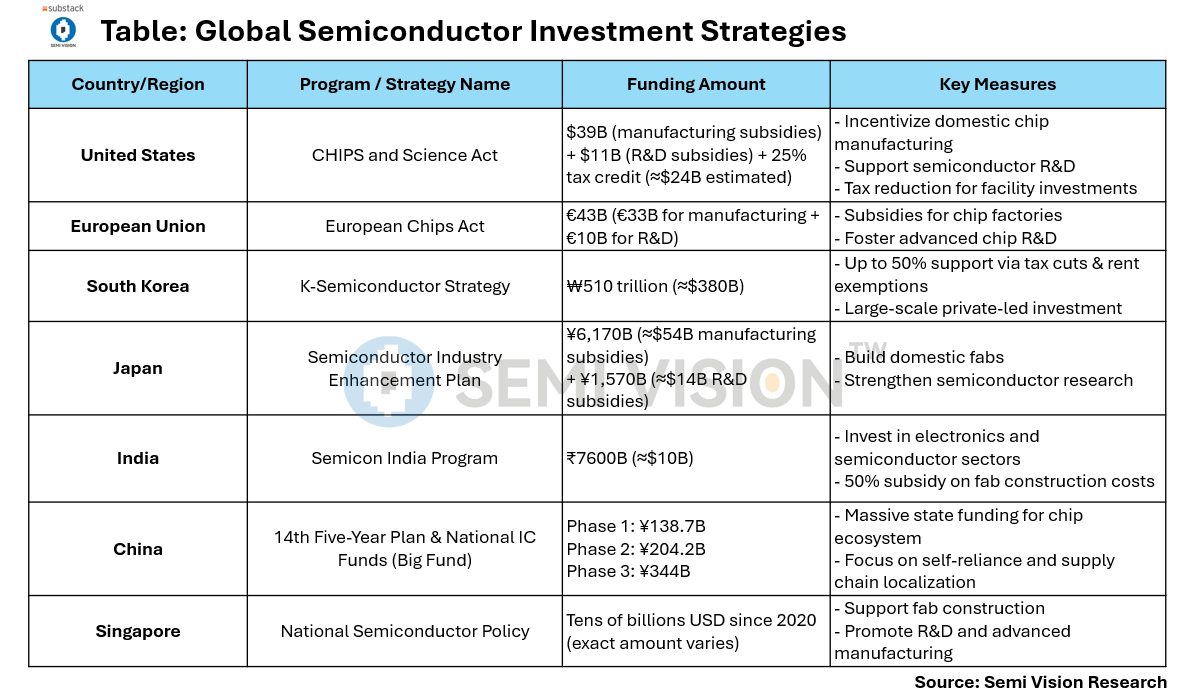
In recognition of chips’ strategic importance, governments across the world have launched ambitious initiatives to boost domestic semiconductor manufacturing and innovation.Semiconductors are now a top policy priority– from Washington to Beijing, capitals are treating chip capacity as vital to economic resilience and national security. Below we overview major countries’ investment strategies, funding programs, and incentives aimed at strengthening their semiconductor ecosystems:

United States:
“Rebuilding Silicon Sovereignty — Innovate, Secure, Lead.”

The U.S. has enacted the landmarkCHIPS and Science Act (2022), which allocates over $75 billion to “jumpstart American competitiveness” in semiconductors. This includes $52.7 billion in direct funding for the chip industry – notably $39 billion in incentives to build and expand fabs in the U.S., and $13 billion for R&D and workforce development. There are also targeted funds, like $2 billion for the Defense Department to secure military chip supply, $500 million via the State Department for international supply chain security, and $1.5 billion for telecom (5G/Open RAN) chips. In addition, the law created a 25% investment tax credit for semiconductor manufacturing, estimated to be worth $24 billion. Beyond the CHIPS Act, the U.S. is increasing federal research support (authorizing ~$170B for science agencies over 5 years) to maintain its edge in chip technology. Tax incentives, streamlined regulations, and large grants are all being deployed to boost onshore chip production and reduce dependence on East Asian fabs. Major projects announced under these incentives include new fabs by Intel in Arizona and Ohio, TSMC in Arizona, Samsung in Texas, and expansions by memory makers – representing tens of thousands of new jobs. The U.S. strategy couples immediate capacity expansion with long-term R&D – aiming to regain leadership in cutting-edge logic chips and secure supply of older chips needed in autos, appliances, and defense.

European Union:
“Chips for Europe — Resilience Through Unity and Innovation.”
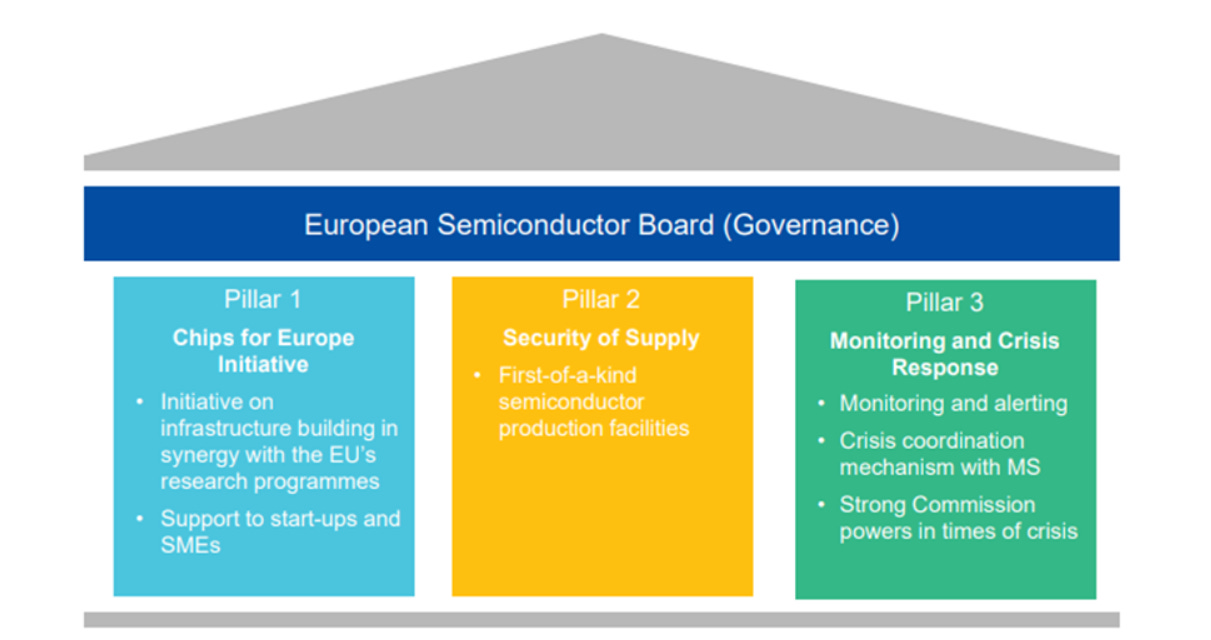
The EU has approved its ownEuropean Chips Act (2023), aiming to mobilize €43 billion (≈$47 billion) in public and private investment into Europe’s semiconductor sector by 2030. This includes roughly €3.3 billion in EU central funding for R&D and pilot lines, plus easier state aid rules that enable individual EU countries to pour billions into chip factories.
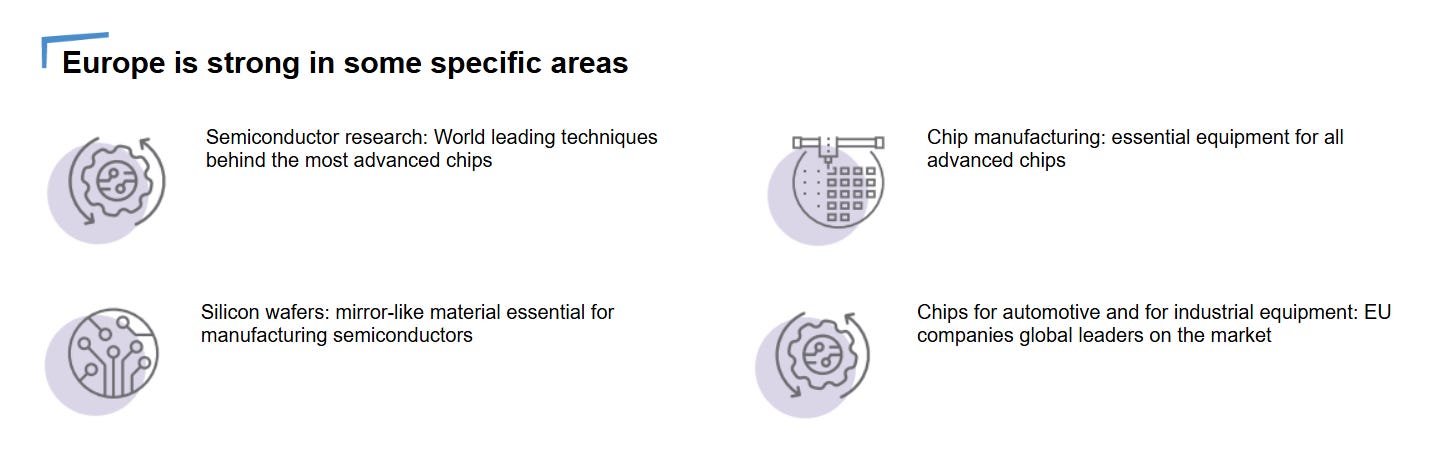
In total, with coordinated national subsidies and industry co-investment, over€100 billioncould be driven into European chips by 2030. The EU’s strategy has two thrusts:attract leading chipmakersto build cutting-edge fabs in Europe, andsupport local players(like Infineon, STMicroelectronics, ASML) in expanding capacity and innovating. To lure big projects, EU nations have put forward massive incentive packages – for example, Germany offering around €10 billion to Intel for a planned mega-fab, and €5 billion to TSMC (with partners) for a new fab in Dresden.

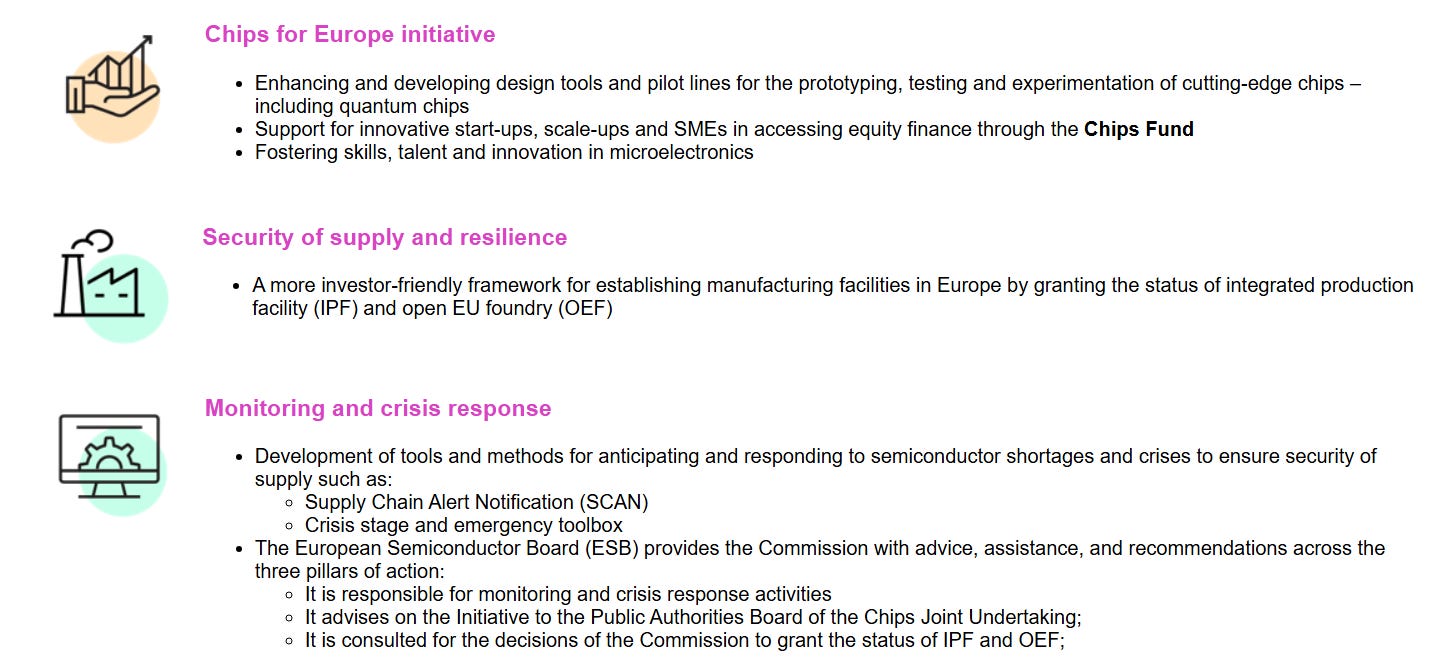
France is backing a new STMicro/GlobalFoundries fab with subsidies, and Italy has eyed projects in chip packaging. These efforts are about resilience and “technological sovereignty” – the EU currently has only ~10% of global chip output and wants to double that share. European governments are thus funding everything from advanced semiconductor research centers (through theChips for Europeinitiative) to workforce training, hoping to cover gaps in the supply chain. While the EU has strength in semiconductor equipment (ASML’s lithography) and automotive-grade chips, it lacks leading-edge logic fabs – hence partnering with foreign firms is a centerpiece of its plan. Generous grants, tax breaks, and streamlined permitting (a big issue in Europe) are being offered to get fabs built on European soil. The EU’s approach is a mix of industrial policy and international collaboration to reduce reliance on overseas chip supplies.
Japan:
“Back to the Core — Reviving Japan’s Semiconductor Spirit.”
Japan has launched a “national project” to revitalize its semiconductor industry, budgeting 3.9 trillion yen (~$26 billion) in state support from 2022 to 2025
This amounts to 0.71% of Japan’s GDP – a higher share than even the U.S. or EU are investing – underscoring how critical Japan views chips for its economic security. The Japanese strategy, outlined by METI (Ministry of Economy, Trade and Industry), has three phases or goals: (1)Strengthen domestic production capacity– mainly by subsidizing new fabs for mature but essential chips; (2)Jointly develop next-generation chip technologywith partners (e.g. the U.S.), exemplified by the new Rapidus venture for cutting-edge <2nm logic chips; and (3)Pursue game-changing future technologies(such as pioneering 6G-era chips that merge photonics and electronics) to leap ahead. In phase 1, Japan leveraged partnerships with Taiwan: it provided hefty subsidies (approaching $8 billion) to entice TSMC, along with Sony and Denso, to set up a fab in Kumamoto that will produce 22/28nm chips for automotive and industrial use.

That joint venture, Japan Advanced Semiconductor Manufacturing (JASM), is now building a second fab with additional partners like Toyota. Phase 2 led to the creation ofRapidus, a consortium of major Japanese companies (Toyota, Sony, NTT, SoftBank and more) with ~$2 billion in initial state support, partnering with IBM to develop 2nm logic technology domestically.
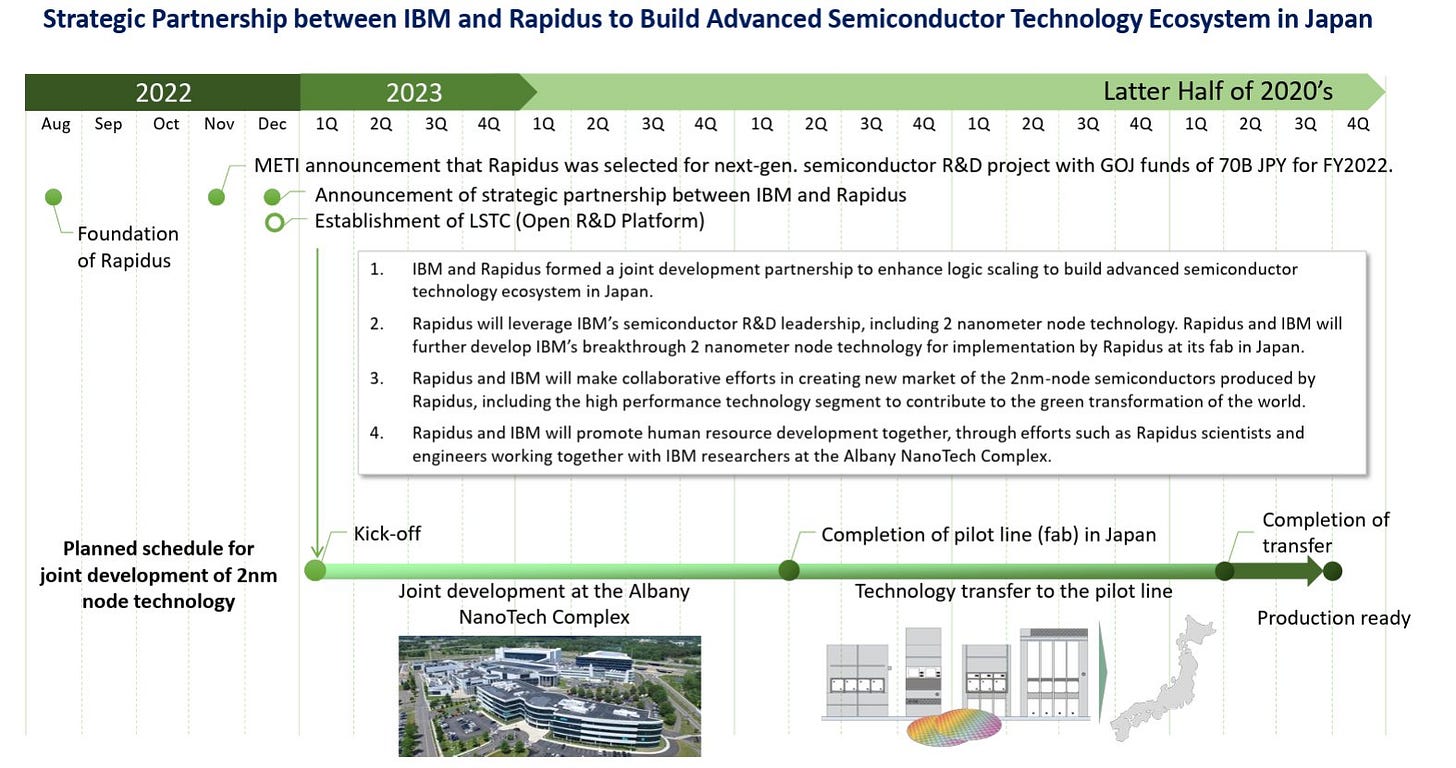
A new R&D hub, the Leading-Edge Semiconductor Technology Center (LSTC), was also established to support Rapidus with research in chip design, materials, and manufacturing processes.
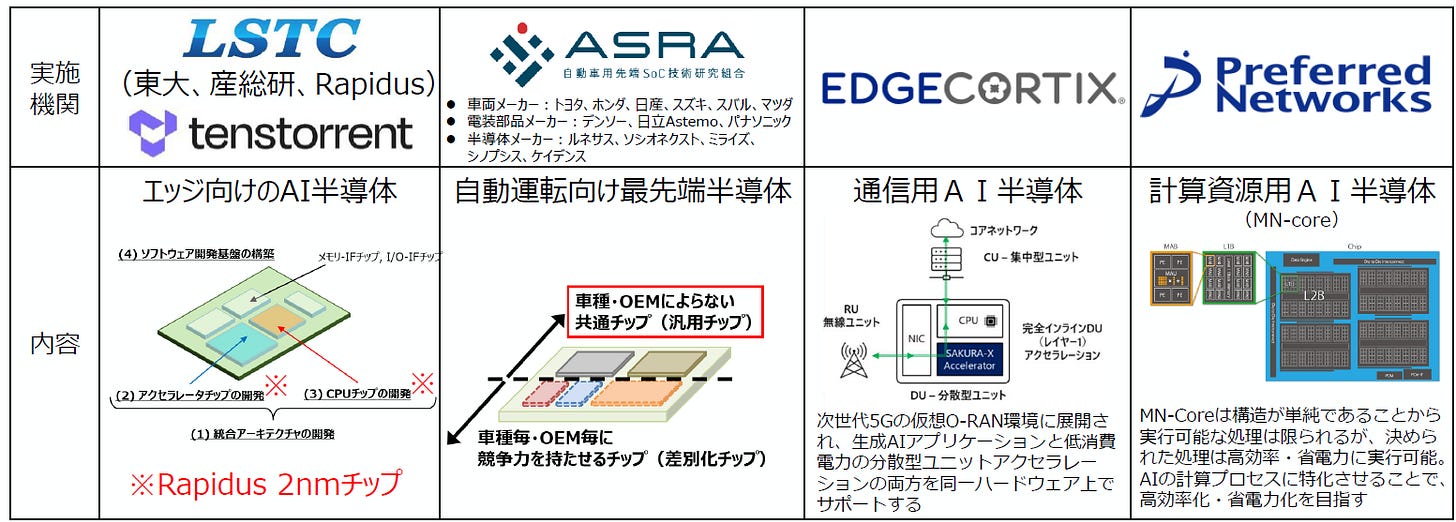
Phase 3 looks further ahead: Japan aims to be a leader in post-silicon technologies like quantum computing and photonic chips by late 2020s. To facilitate all this, the government is also investing in workforce development after years of decline in its semiconductor talent base. In sum, Japan’s approach combines massive subsidies, international alliances, and a focus on specific niches (like chips for autos and future 6G networks) to spark a “renaissance” of its chip sector . Once a chip powerhouse in the 1980s (with ~50% global market share) Japan had fallen below 10% share; now it is determined to claw back relevance through strategic investment.
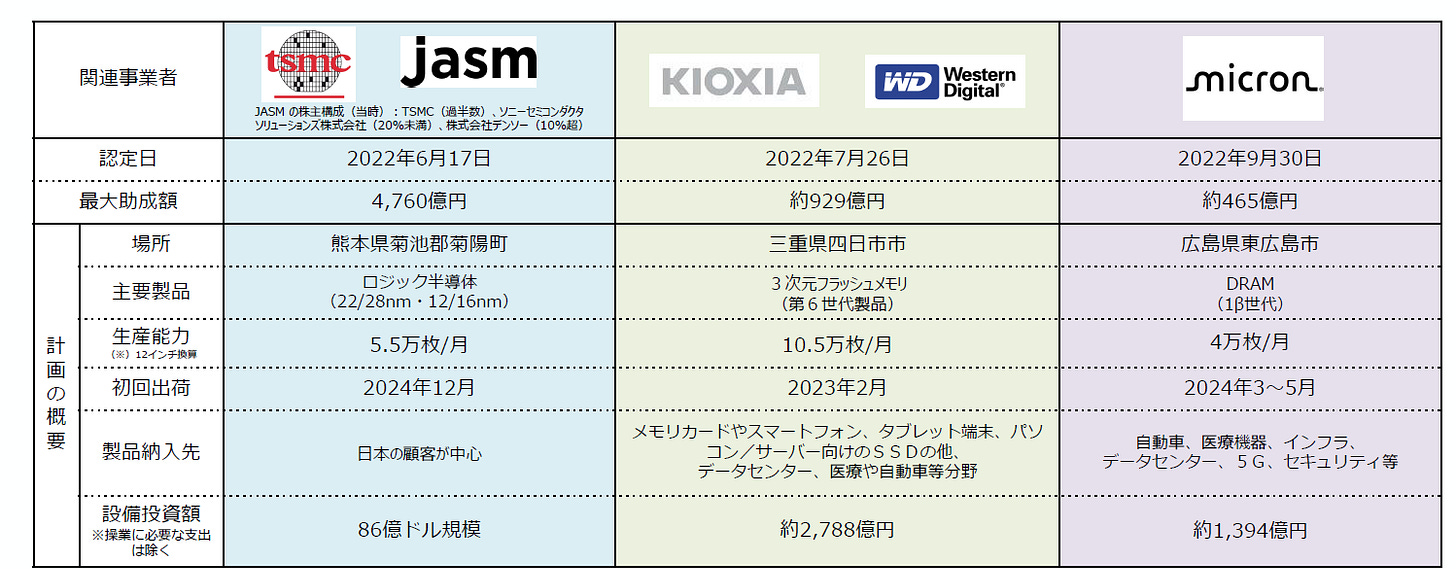
To support investment decisions in developing a production base for advanced semiconductors, the 5G Promotion Act and the NEDO Act were amended and came into effect on March 1, 2022. Under these laws, a total of funding has been allocated across multiple fiscal years to support such initiatives:
¥617 billionin the FY2021 supplementary budget,
¥450 billionin the FY2022 supplementary budget, and
¥632.2 billionin the FY2023 supplementary budget.
By February 2024, the Minister of Economy, Trade and Industry has approved six plans for the establishment and production of advanced semiconductor manufacturing facilities.
The JASM Building No. 1 Project, approved in June 2022, has completed preparations for mass production as scheduled in December 2024.

South Korea:
“From Memory to Mastery — Leading the Next Generation of Semiconductors.”
South Korea relies on its corporate giants Samsung Electronics and SK Hynix – already world leaders in memory chips and major players in logic – to drive its semiconductor ambitions. The government’s role has been to foster a favorable environment for these firms’ colossal investment plans. In 2021, South Korea unveiled a vision to spend ₩510 trillion ( ~$450 billion) over 10 years to cement itself as the “world’s largest semiconductor supply chain” by 2030.

Notably, the bulk of that $450 billion comes from the private sector (Samsung, SK, and numerous smaller chip companies), while the government is supporting via aggressivetax incentivesand infrastructure. For instance, Seoul is offeringtax credits of 40–50% for R&D and 10–20% for facility investmentsin semiconductors – extremely generous breaks aimed at spurring companies to build cutting-edge fabs domestically. In early 2023, the government further proposed raising the tax deduction on semiconductor capital investments by large firms to 15% (up from 8% previously, plus extra incentives for SMEs)
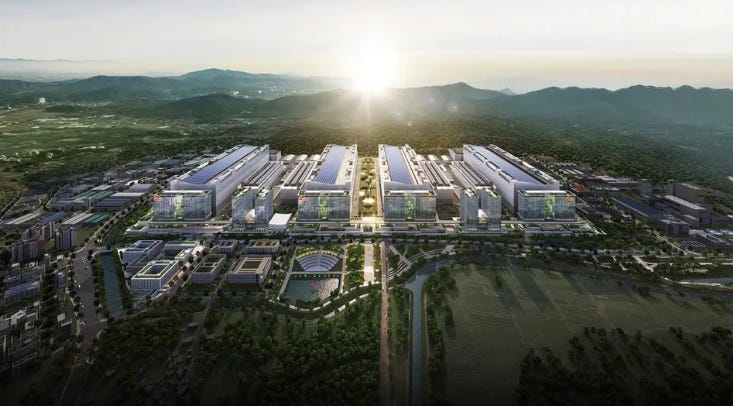
President Yoon also announced eased regulations and support for a mega-cluster of fabs near Yongin (south of Seoul) where Samsung alone plans to invest $230 billion over two decades. In short, South Korea’s strategy is“let the champions lead”– empower Samsung and SK Hynix to pour hundreds of billions into bothleading-edge logic chips and next-gen memory, so that Korea remains indispensable in global supply. Samsung, for example, is expanding its foundry business (aiming to rival TSMC in contract chipmaking) and increasing advanced R&D spending; SK Hynix is investing in new fabs for DRAM and NAND flash. The Korean government facilitates these moves with capital allowances, low-interest loans, and land provisions. The scale of Korea’s private investment has been so large that one analyst noted“the Biden administration’s $50 billion seems paltry in comparison”.
By aligning policy with corporate strategy, South Korea intends to sustain its edge in memory chips and capture a bigger slice of the logic and fabless market – essentially doubling down on semiconductors as its economic growth engine (chips already are ~15% of Korea’s exports). One risk is heavy reliance on a couple of firms, but so far that formula has made Korea a chip superpower.’

China:
“Self-Reliance in Silicon — Building a Strong and Independent Chip Ecosystem.”
China has made domestic semiconductor self-sufficiency a cornerstone of its industrial policy, especially after facing increasing U.S. export restrictions. The government’s approach is an all-out,“whole-of-nation”effort: huge state-backed funds, tax breaks, procurement preferences, R&D programs, and protection of local firms – all geared toward reducing China’s reliance on foreign (especially U.S.) chip technology. Central to this is China’s National Integrated Circuit Industry Investment Fund, nicknamed the “Big Fund.” Since 2014, it has launched three funding rounds: the first raised 138.7 billion yuan ($22B) in 2014, the second 204 billion yuan ($29B) in 2019, and the latest 344 billion yuan (~$47.5B) in 2023. This third phase is the largest yet, underscoring President Xi Jinping’s drive for chip self-reliance.
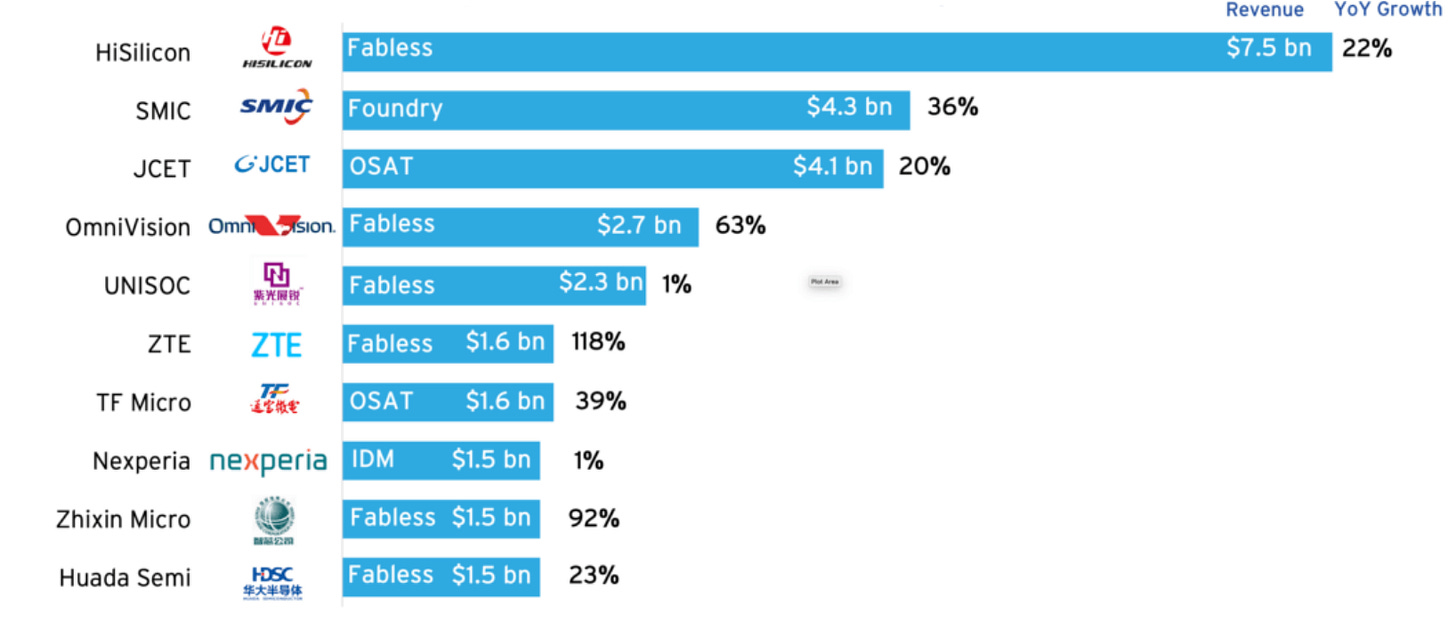
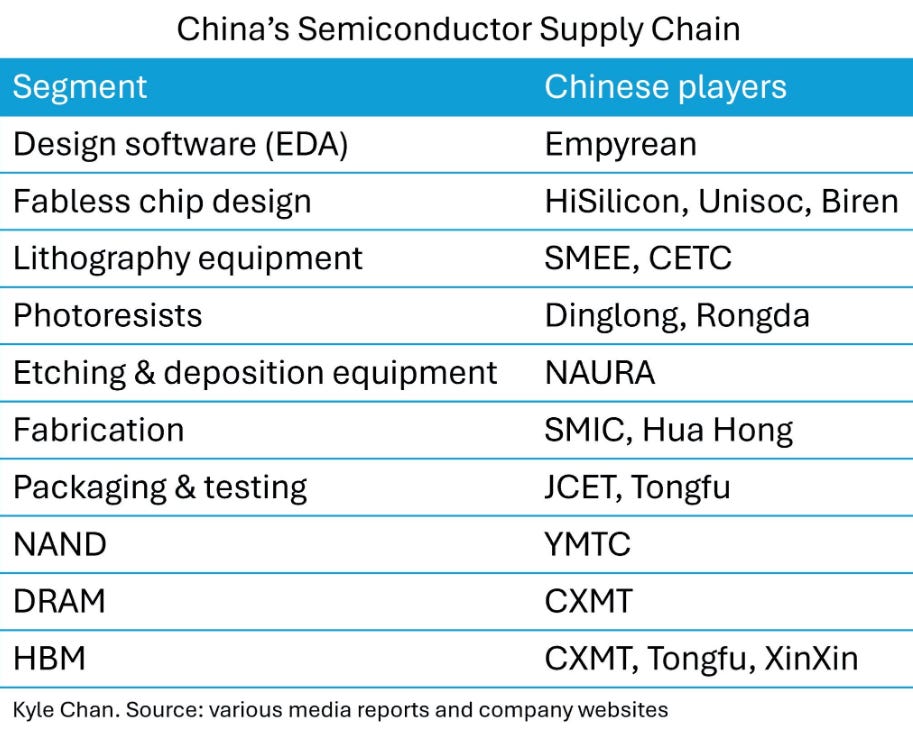
The Big Fund invests in Chinese chip companies across the supply chain – from foundries like SMIC and Hua Hong to fab tool makers, materials suppliers, and chip designers. Beyond the Big Fund, dozens of provincial and city governments in China have their own semiconductor funds and incentive programs, which have committed tens of billions more (though with mixed success and some high-profile project failures). Beijing’s central government has also issued tax relief – for example, qualifying chip enterprises can get 10-year corporate tax exemptions or reduced rates, depending on the technology node. The Made in China 2025 plan (announced in 2015) explicitly set targets for 70% self-sufficiency in chips by 2025; while that target won’t be met, it drove massive investments in local fabs and chip design start-ups. In 2020, after the U.S. cut off Huawei from chips, China elevated semiconductors even further in its national agenda, pouring more R&D money through programs like “02 Special Project” for advanced process development. The 14th Five-Year Plan (2021–25) places semiconductors as a top priority, aiming to build a full indigenous semiconductor ecosystem (from EDA software to lithography machines).

By 2022, Chinese firms were designing competitive chips (e.g. Huawei’s HiSilicon) but manufacturing at scale still relied on foreign tech.

Hence, China’s strategy has also come to include “import substitution” – e.g. government subsidies to replace foreign chips in sensitive applications (military, telecom, finance) with Chinese-made ones. Billions are being funneled into talent programs, new semiconductor universities and fabs (over 50 new fab construction projects were announced in China in the past few years). However, U.S. export controls (discussed later) have begun to bite, denying China access to the most advanced tools and chips. In response, China is focusing its funds on areas like mature-node chips (28nm and above), memory chips, and chip equipment – where it hopes to catch up despite the sanctions. In summary, China’s government is spending unprecedented sums – well over $100 billion in aggregate – to achieve a vertically integrated, homegrown chip industry that can survive decoupling. This state-led approach has vaulted China to the forefront in some segments (it now leads in sheer volume of chip production capacity installed, though mostly older tech), but it still strives for breakthroughs in cutting-edge logic and lithography, which remain difficult without foreign collaboration.
India:
“Make in India, Chip for the World — Rising Through Design and Manufacturing.”
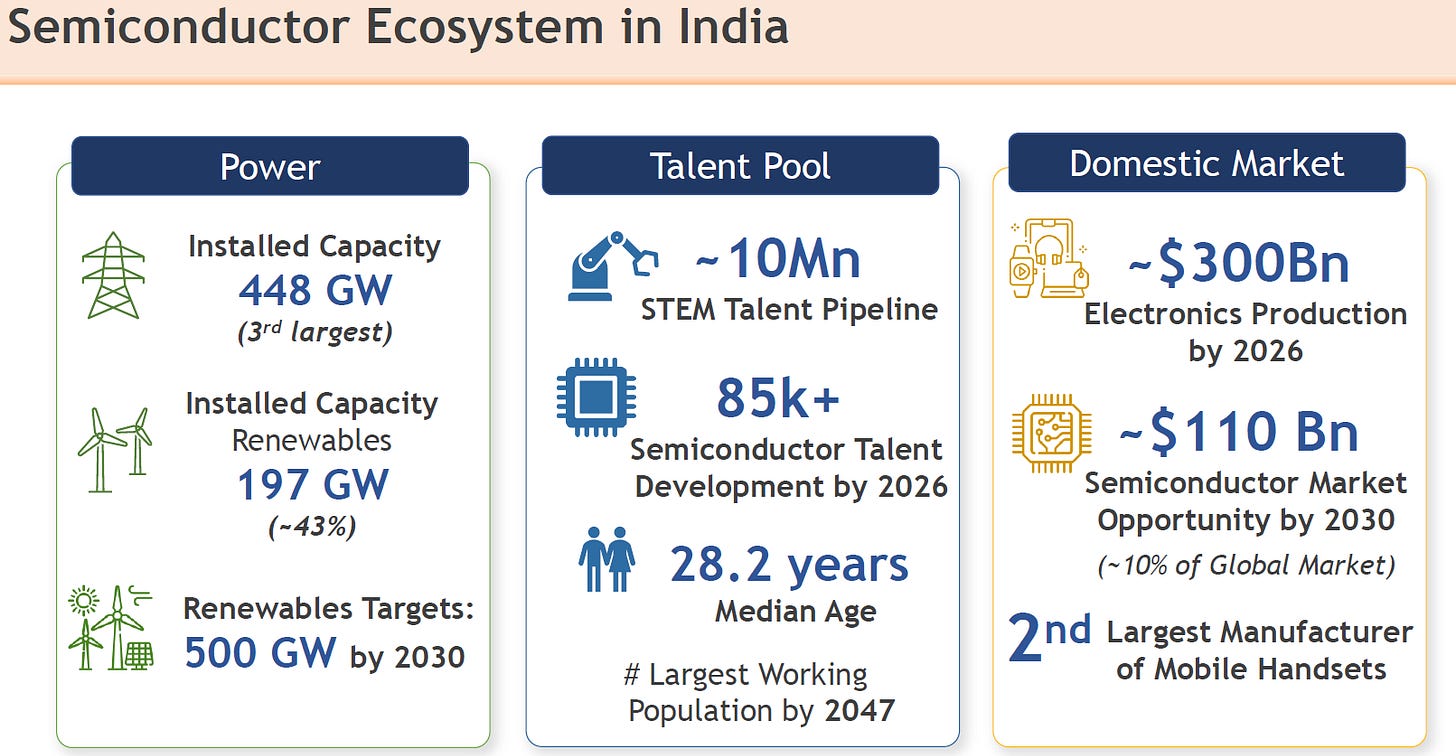
India is a newcomer to major semiconductor manufacturing, and its government has launched the“India Semiconductor Mission”to change that. In late 2021, India approved a$10 billion incentive packageto attract chip and display manufacturers. Under this plan, the government will coverup to 50% of project costsfor companies setting up fabs in India.

The goal is to establish at least a few domestic chip factories and make India a player in the supply chain, leveraging its strengths in engineering and its huge electronics market. Several proposals have emerged: a joint venture by an Indian conglomerate (Vedanta) with Foxconn was initially in the running to build a fab (though it has faced setbacks), and other consortia involving foreign firms like Tower Semiconductor (from Israel) have expressed interest
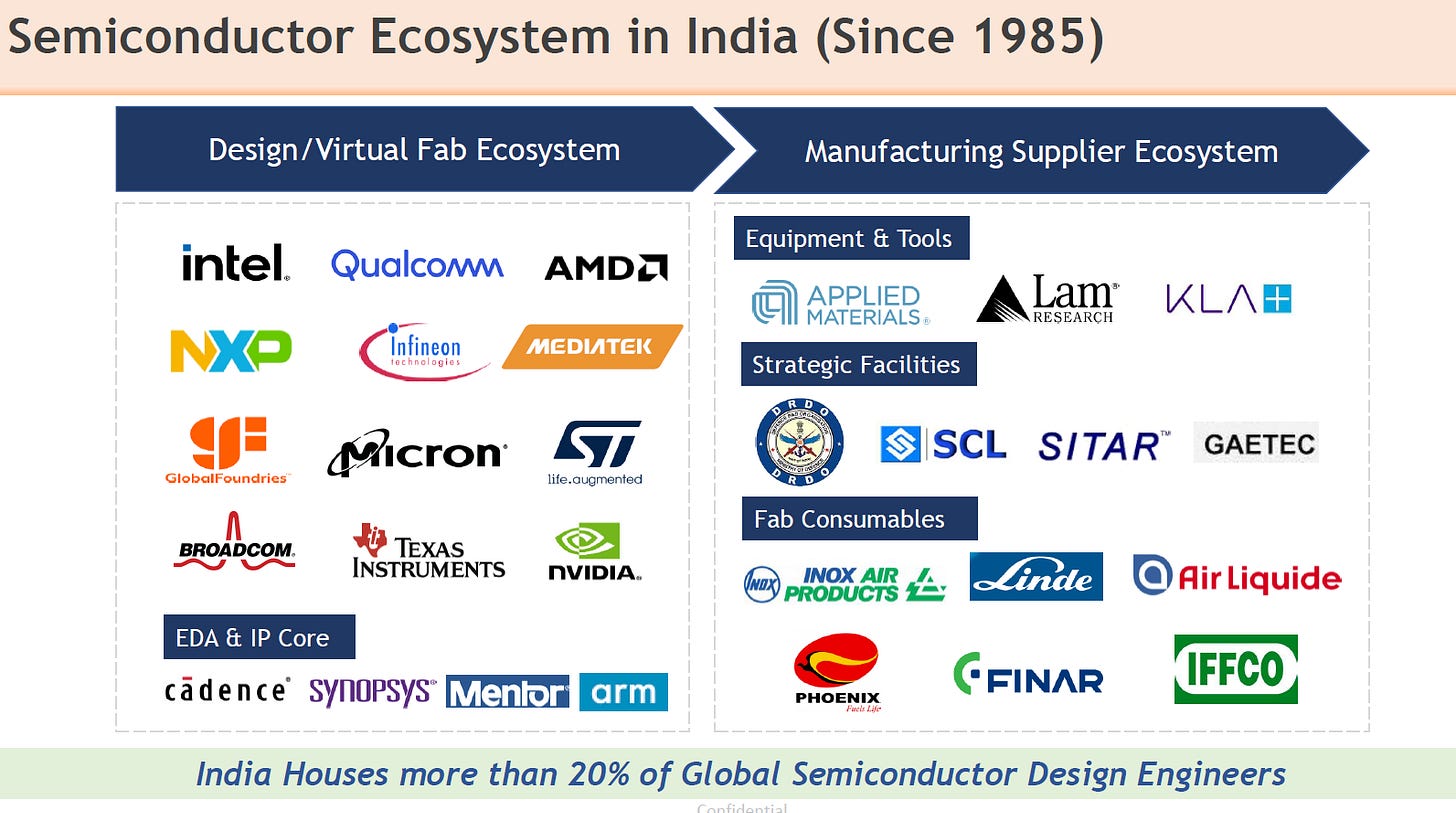
Thus far, India’s progress in landing a cutting-edge fab has been slow – challenges include lack of existing infrastructure and ecosystem – but the government has sweetened offers withcheap land, subsidized utilities, and swift permitting, in addition to the capital subsidy. India is also incentivizingchip design startups and semiconductor R&Dwith separate schemes totaling $1–2 billion.
In 2023, as the original $10B got tied up in applications, the government indicated it may allocate an additional$10Bto continue the mission

A bright spot came whenMicron (USA)agreed in mid-2023 to build a $2.75B semiconductor assembly and test facility in Gujarat, with$1.3B in Indian central and state subsidies– marking India’s first major win in the chip space. While that is for packaging rather than chip fabrication, it’s a start for India’s ambitions. Strategically, India sees an opportunity to become anew destination for chip productionas companies seek to diversify beyond China (a policy often dubbed “China + 1”). With its large talent pool (India produces many engineers who work in chip design globally) and government backing, India hopes to establish itself in semiconductors in the late 2020s. Its approach is very muchpartnership-driven– courting foreign chipmakers (from Taiwan, Israel, US) to team with Indian firms, and emphasizing political stability and market access (for example, linking chip investment to access to India’s growing electronics market). While results will take time, New Delhi’s commitment of resources signals it is serious about joining the semiconductor club.
India Okays $15 Billion of Milestone Chip Plant Investments
Geopolitical Flashpoint: U.S.–China Tech Tensions and Export Controls

The rivalry between the United States and China over semiconductor technology has escalated into a tech cold war, with export controls at its frontline. Starting in 2022, the U.S. has imposed a series of sweeping restrictions aimed atcutting offChina’s access to advanced chips and the equipment used to make them. These measures mark perhaps the biggest geopolitical disruption to the chip supply chain, as they not only affect the U.S. and China, but also third-party countries and companies worldwide caught in the policy crossfire. Here we outline the key events from 2022 to 2024 and analyze their impact:
August–September 2022: The U.S. began tightening the noose by targeting specific high-performance chips. In late August, U.S. officials ordered Nvidia and AMD to halt exports to China of their top AI accelerator chips (like Nvidia’s A100)
. These GPUs are crucial for training AI models and military applications. This move alerted Beijing that more was coming. Sure enough, by early September 2022, reports emerged that China’s AI leaders, such as Alibaba and SenseTime, were scrambling to stockpile chips or find workarounds. The Nvidia restriction was a precursor to broader controls.
October 7, 2022: A watershed moment – the U.S. Commerce Department’s Bureau of Industry and Security (BIS) unveiled a“sweeping set of export controls”on China
. These rules did several big things at once: (1) Banned exports to China of cutting-edge logic chips (defined by certain performance thresholds) no matter where they are made, if U.S. technology is involved (the so-calledforeign direct product rule, which extended U.S. controls globally)
. This effectively barred China from buying the most advanced AI and supercomputing chips, even if they were made by, say, TSMC in Taiwan, because U.S. IP is in those chips. (2) Barred exports of critical chip manufacturing equipment to China, specifically tools needed to fabricate logic chips at ~16nm or smaller, DRAM at 18nm half-pitch or smaller, and NAND flash with 128 layers or more. This hit China’s leading fabs (SMIC, YMTC, etc.), preventing them from getting gear to advance their process technologies. (3) Restricted U.S. persons from supporting Chinese fabs – an extraordinary measure that meant American citizens or green card holders could not work on certain Chinese chip projects without a license, leading to an exodus of American engineers from Chinese semiconductor firms overnight. (4) Placed new Chinese entities on the Entity List (trade blacklist), meaning any export to them requires a license likely to be denied. The October 7 package was sweeping in scope; its intent was clear: to freeze China’s capabilities at a point well behind the cutting-edge. Chinese companies suddenly found themselves unable to buy top-tier chips or the machinery to make them. This U.S. action was a unilateral but highly impactful decoupling move, described as “strangling with an intent to kill” China’s advanced chip development by one expert. Beijing denounced the move as economic coercion. Immediately, we saw effects: for example, Apple cancelled plans to use YMTC’s NAND chips in iPhones, and Chinese memory champion YMTC itself reportedly had to halt expansion and lay off staff
. China’s leading fab SMIC, which had just started 7nm prototype production, said its progress was stalled by lack of equipment

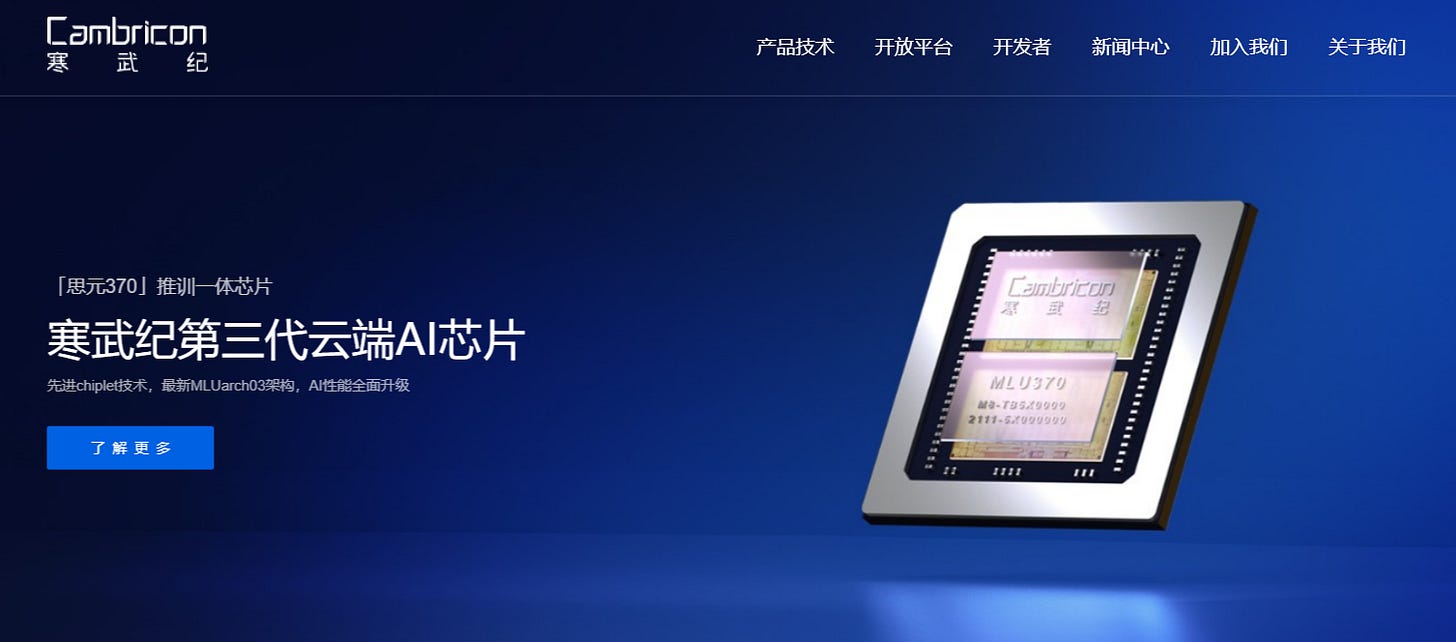
December 2022:The U.S. expanded its Entity List, adding36 more Chinese chip-related companies, including the major memory makerYMTCand leading AI chip design firms like Cambricon.

. This further cut off China’s players from U.S. inputs. Notably, YMTC’s addition aimed to stop it from acquiring equipment to mass-produce advanced NAND (where it was catching up to Samsung). The December blacklist also included many semiconductor materials and component suppliers in China. As 2022 closed, China’s ability to procure high-end tech was severely curtailed.
January 2023:Behind closed doors, the U.S. achieved a diplomatic win – persuading its allies Japan and the Netherlands to join in restricting chip equipment exports to China. The three countries together dominate the high-end semiconductor equipment market (with firms like ASML, Nikon, Tokyo Electron, Applied Materials). In late January 2023, media reported that Japan and Netherlands agreed to mirror the U.S. export ban on advanced lithography and other tools for China. This wasn’t publicly announced immediately, but it was a significant alliance move: it closed a potential loophole where China could source non-U.S. equipment from these countries. By mid-2023, both countries implemented new rules (e.g., the Netherlands in June 2023 formally announced limits on exporting certain immersion lithography machines capable of sub-14nm production)
This showed a growingtech allianceaimed at China, with the U.S. as ringmaster.
Mid 2023 – China’s Response:China did not sit idle. In retaliation, China restricted exports of key raw materials for chipmaking. In July 2023, Beijing imposed controls on exports of gallium and germanium – two minor metals essential for making semiconductors and military devices.

China happens to produce the majority of the world’s gallium and germanium. The move was largely symbolic (for now) and served as a warning shot: China could leverage its dominance in certain materials supply as counter-measures. It forced chip industries elsewhere to scramble for alternative sources of those elements. This was seen as Beijing signaling that if its chip imports are choked, it can retaliate upstream in the supply chain. Also, throughout 2023, China accelerated efforts to remove foreign tech: for instance, instructing state firms to replace foreign-made PCs and chips with domestic ones where possible. And importantly, Chinese firms started developing workaround products – e.g., Nvidia created lower-performing versions of its AI chips (A800, H800) that met the October 2022 export thresholds so they could still be sold to China. SMIC controversially managed to produce a 7nm chip (for a Chinese cryptocurrency miner) using DUV lithography, showing some resilience. These actions highlighted an ongoing cat-and-mouse dynamic.
October 17, 2023:The U.S. BIS released an updated set of export control rules, essentially tightening the 2022 controls to close loopholes
. Key updates: (1) Refined performance thresholds for AI chips – the U.S. realized Chinese firms were getting by with slightly gimped versions (like Nvidia’s A800, which was designed to comply with 2022 rules yet still deliver ~70% of an A100’s performance). The new rules introduced metrics like “Total Processing Performance (TPP)” and “performance density” to more granularly restrict AI chips, catching those tweaked models
. In effect, chips like Nvidia’s A800/H800, which had avoided the ban, were now explicitly banned without a license
. (2)Expanded equipment bans– ensuring that even more types of tools (like for advanced packaging, which could potentially help China circumvent node limitations by chip stacking) were controlled. (3) Added dozens of Chinese firms to the Entity List, including cloud computing providers that were offering AI chip rental services to sanctioned companies (a workaround identified where blacklisted firms accessed advanced chips via cloud providers)
. The October 2023 updates also made it harder for China to acquire lesser but still significant chip tech; for example, certain less advanced lithography tools or older generation NVIDIA chips were further restricted to prevent stockpiling. The U.S. essentiallyraised the wall higherafter observing China’s adaptations over the prior year. The rules also introduced a mechanism for allied countries to be excepted from some controls (e.g. chips going to Korea or Taiwan wouldn’t be caught in the net) while making sure China and other “countries of concern” (like Russia) remain blocked
. By end of 2023, the U.S. had firmly established itself as the de facto regulator of who can access high-end semiconductor tech, given its leverage over the global supply chain
Early 2024:The effects of these controls continued to reverberate. In January 2024, the Netherlands’ export curbs (agreed in 2023) formally went into effect, meaning ASML can now no longer ship even some immersion DUV lithography machines to China without a license – further hampering Chinese fabs’ ability to make sub-28nm chips.

Japan also implemented similar restrictions on its chip tool exports around the same time. Meanwhile, reports emerged that Chinese tech companies were investing heavily in developing homegrown lithography systems and exploring older chip architectures to mitigate U.S. controls. The U.S. Congress and executive branch signaled that export controls will be an ongoing, iterative policy – with potential to tighten further if, for instance, China makes breakthroughs or if U.S. intel spots violations. The geopolitical tension remains high: China filed a dispute at the WTO against U.S. chip controls (and against Japan’s and Netherlands’ following suit), but many analysts consider this more a symbolic protest given national security exemptions in trade rules.
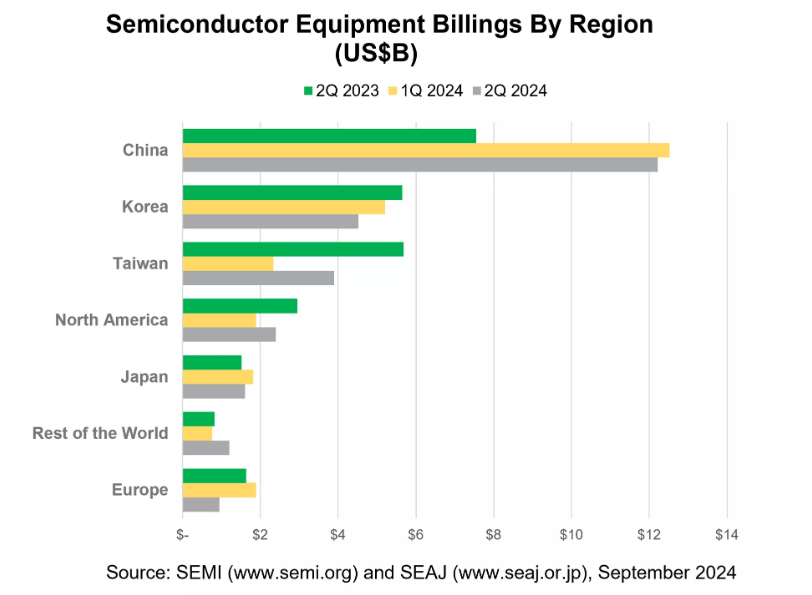
Theimpactof these export controls has been profound. In the short term, theyslowed China’s progress in advanced semiconductors– e.g., without EUV tools, China’s hopes for a 5nm process are stalled; without top-tier Nvidia or AMD AI chips, Chinese AI firms have to use less efficient alternatives or design their own (Huawei did spin out new chips using 7nm tech in 2023, a partial success that surprised observers). U.S., European, Japanese and Taiwanese firms have had to decouple certain supply relationships – for instance, Lam Research and Applied Materials (U.S. toolmakers) saw reduced business from China, and ASML must navigate losing a chunk of its customer base. Some companies, like ASML, expressed concern that in the long run, shutting out China (which was ~15% of its sales) could hurt revenue that funds future R&D – a potential“own goal”risk for the West. There’s also the risk of Chinese retaliation beyond materials export curbs – e.g., China in 2023 initiated a probe into Micron (a U.S. memory company) and subsequentlybanned Micron’s products in critical infrastructure usage in China, which can be seen as tit-for-tat after YMTC’s blacklist. The tit-for-tat could escalate further if, say, China were to detain executives or restrict rare earth exports, although it must be careful not to hurt its own interests.
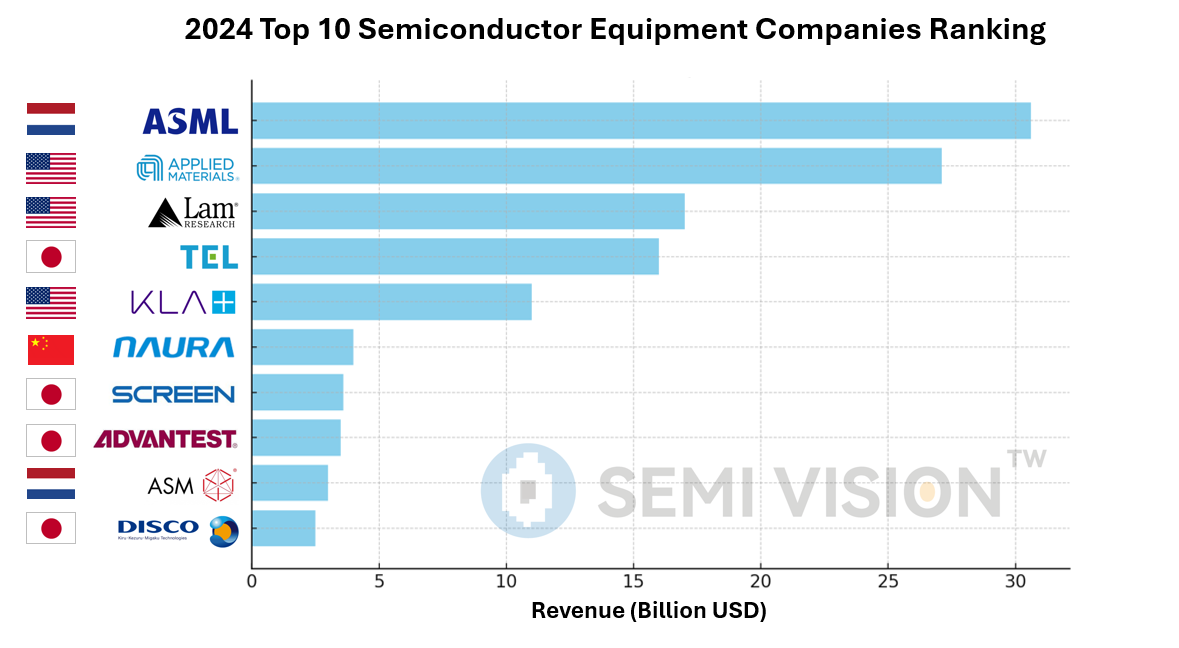
For the global semiconductor ecosystem, the U.S.-China export control battle lines have introduced significant uncertainty and forced reorientation of supply chains. Non-Chinese chip firms are now extremely cautious about dealings with China; many have created “China-specific” product variants (to comply with rules) or started limiting China operations. Some manufacturing is shifting: TSMC, for example, can no longer freely service China’s chip design orders if they involve advanced tech, potentially steering Chinese orders to less optimal solutions or to indigenous fabs. On the flip side, these controls have spurred China to double down on its self-reliance efforts – Chinese chip design startups for AI accelerators have multiplied, and government support for alternative semiconductor technologies (like RISC-V open-source chip architectures, or chiplet integration to leapfrog via packaging) has increased. We may see in a few years a scenario of two parallel tech stacks: one in China that is perhaps 5-10 years behind but independent, and one in the West that is cutting-edge but now decoupled from the huge Chinese market.
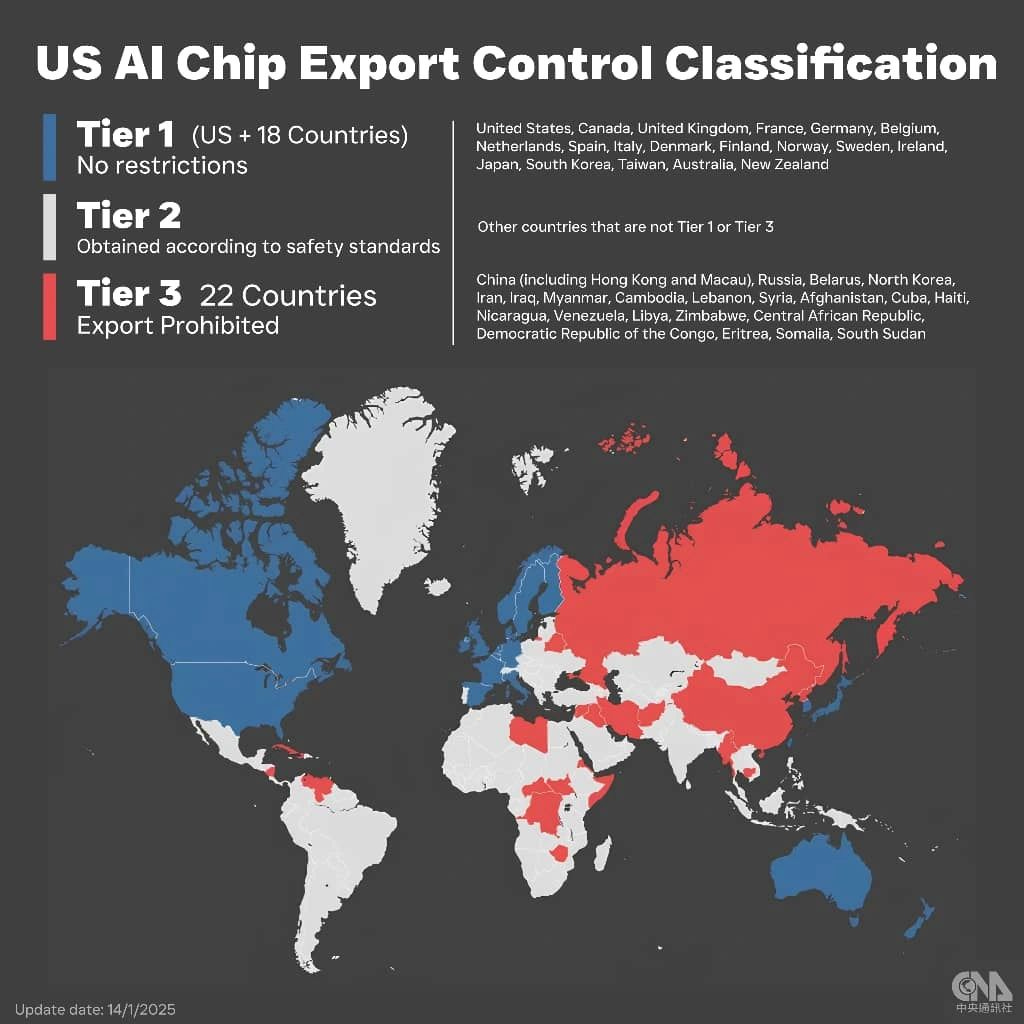
In sum, U.S. export controls (with allied participation) are a geopolitical tool being used to delay and ideally derail China’s attainment of leading-edge semiconductors, given the belief that cutting-edge chips have military significance (enabling advanced AI for intelligence, autonomous systems, etc.). These controls represent ahigh-stakes gamble: they impose short-term pain on Chinese companies, but also on U.S. companies losing sales (estimated tens of billions in the case of the October 7 rules). The U.S. has judged that the national security benefits outweigh the costs. As a consequence, the semiconductor industry – which thrived on globalization – is now subject to geopolitical bifurcation, where access to technology is determined by political alignments. This flashpoint will continue to shape industry dynamics, as companies restructure their product lines and China accelerates efforts to carve out a sanctions-proof chip sector. The next section will look at how countries are also formingalliances and partnershipsin the chip space, which in part is a response to these tensions – with like-minded nations working together to secure supply chains that bypass potential adversaries.

Risks, Implications, and Outlook for the Global Supply Chain
The geopolitical tug-of-war over semiconductors brings both potential benefits (like improved resilience for those in alliances) and significant risks. As the industry enters this era of partial de-globalization, we must consider the possible consequences and challenges ahead:
Fragmentation and Inefficiency:A major risk is that the global semiconductor supply chain – which historically was optimized for efficiency and cost, with each region specializing – could fragment into siloed blocks. Duplication of efforts is already evident: multiple countries are building the same types of fabs and R&D centers now, in pursuit of self-reliance or security. This raises the danger of overcapacity in some areas and bottlenecks in others. For example, if the U.S., Europe, and India all succeed in adding fabs for, say, 28nm chips (which are needed for cars, IoT, etc.), we might swing from shortage to glut, causing a price crash that hurts manufacturers’ profitability. Likewise, every region is pouring money into advanced logic R&D – but perhaps spreading talent thin rather than pooling it. The semiconductor industry is extremely capital intensive with long ROI timelines; inefficient investments due to political mandates could lead to stranded assets (white elephant fabs that aren’t competitive) and a higher cost structure industry-wide. This could ultimately mean higher chip prices for consumers or more volatility in the market.
Supply Chain Vulnerabilities Persist:Ironically, in trying to secure supply chains, some new vulnerabilities may appear. Each country can’t do everything well; dependencies will remain. For instance, the U.S. and Europe will still rely on ASML in Netherlands for lithography – a single company whose output is a single point of failure (ASML can only make so many EUV machines a year). Similarly, moving manufacturing around creates new weak links – e.g., TSMC building in Arizona: it faces challenges of a new workforce, water scarcity issues in a desert, etc., so a hiccup there could disrupt things as much as a typhoon in Taiwan might. Also, as production diversifies, supply chain management becomes more complex – a chip designed in one country, fabricated in second, packaged in a third now might involve export control paperwork or political approval at each step. The risk of miscoordination or delays increases. Moreover, despite all the talk of decoupling, certain choke points remain global – for example, China still refines the majority of some critical materials and dominates production of substrates and printed circuit boards. If geopolitical tensions worsen, China could restrict those, impacting everyone (including the West). Thus, partial decoupling might reduce some risks but increase others that were previously not front and center.
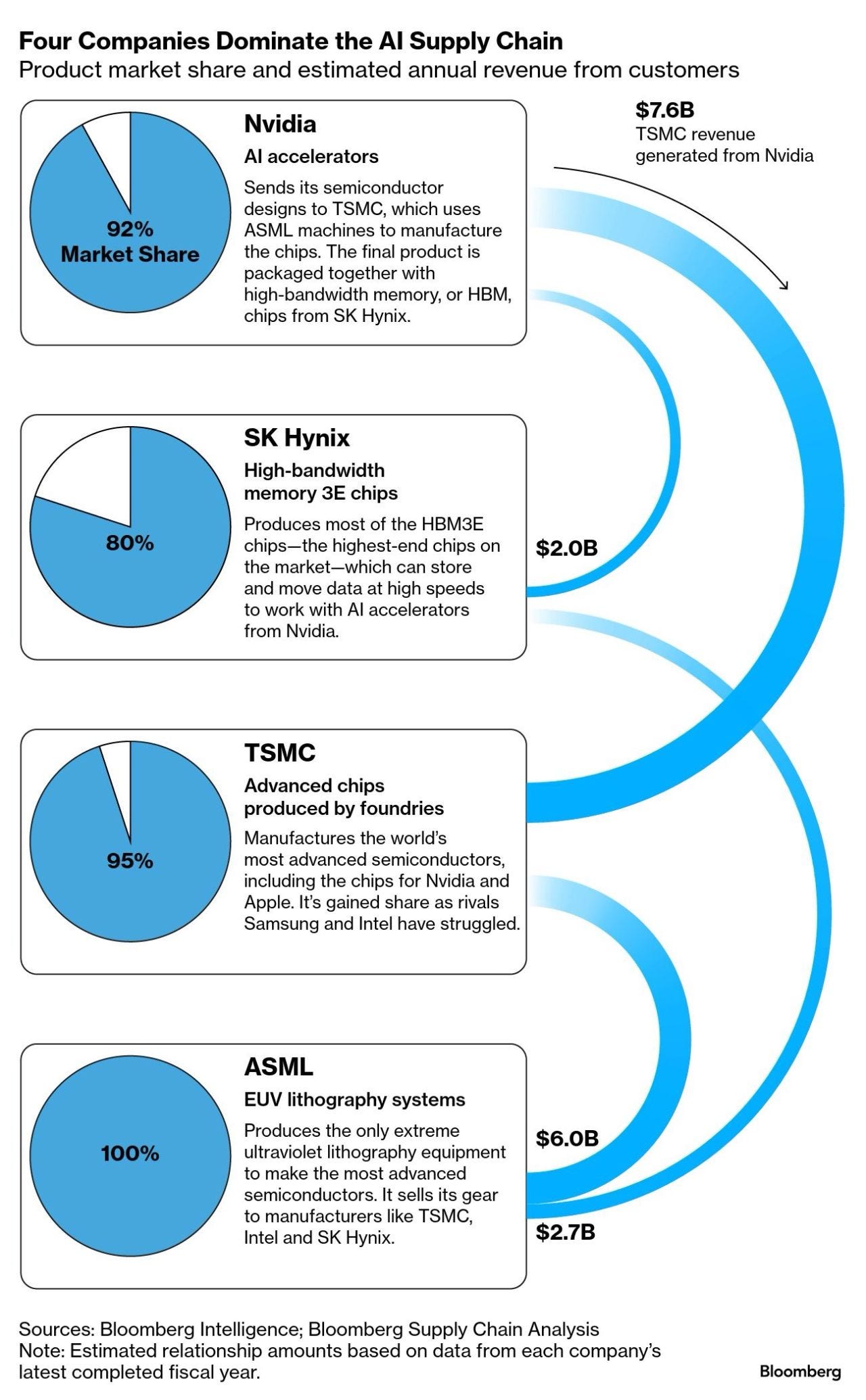
Geopolitical Escalation:The semiconductor tug-of-war could further inflame US-China relations and potentially spark retaliatory cycles. We saw China’s response with material export curbs; it could go further, such as restricting rare earth exports (needed for electronics) or aggressively subsidizing chips flooding certain markets to damage Western firms. There’s also the worst-case scenario: a military conflict, most worryingly in the Taiwan Strait. Taiwan produces over 90% of the world’s most advanced chips; a conflict there would be catastrophic for the supply chain – cutting off those chips overnight. The“silicon shield”notion is that the world’s dependence on Taiwan’s TSMC protects it (everyone has a stake in its safety), but it’s also a vulnerability that underpins why so many are trying to diversify away from Taiwan production. However, until that diversification is achieved (which is years away), the risk remains that a geopolitical event (Taiwan crisis, South China Sea conflict, etc.) could sever critical chip supply lines, causing a global economic shock. Even short of war, political brinksmanship – say China blockading certain exports or the U.S. pressuring allies to fully stop all chip trade with China – could force companies into impossible positions. Allied cohesion might also be tested: if, for instance, a future U.S. administration used export controls even more aggressively, would every ally go along at cost to themselves? Divergences could open if, say, Europe decides its companies should still sell certain older tech to China while the U.S. says no. That could introduce friction within the alliance and create uncertainty for businesses.
Outlook:In the near term (next 2–5 years), we can expect the geopolitical competition to continue driving semiconductor policy. The U.S. will implement the CHIPS Act funding – we’ll see new fabs come online in America by 2024–2025, though ramping to high volume will take time. Europe’s projects (Intel in Germany, etc.) are slated for 2027–2028 timeframe. Japan’s Rapidus aims for pilot production by 2025-2026. China will no doubtincrease its investmentfurther – reports suggest China might invest another $300 billion over the next decade in semis. It will likely manage to become largely self-sufficient in mature chips (say 28nm and older) and memory (NAND, DRAM) in that timeframe, but will still struggle at the cutting-edge if export controls remain stringent. The global market will likely bifurcate for certain products: e.g., Chinese AI chips for the domestic market vs Nvidia/AMD chips for the rest, etc.
One key thing to watch is technological black swans: Could there be a breakthrough that changes the game? For instance, if China made unexpected progress in an alternative lithography technique or in quantum computing that leapfrogs traditional chips, it could upend assumptions. Conversely, if the U.S. or an ally makes a breakthrough (like optical computing, or a new chip architecture that sidesteps current limits), that could either widen their lead or open new fronts.
Another factor is political change: These strategies span many years and could be affected by elections and policy shifts. A new U.S. administration might take a different tack on export controls (either tougher or more lenient). Allies might change subsidy focus if budgets tighten or if there’s backlash about spending taxpayer money on fabs of foreign firms. Chinese policy, heavily top-down, is likely to remain consistent as long as current leadership is in power, but economic strains in China (local debt, etc.) could limit how much money they keep throwing at semis versus other needs.
In a positive scenario, the intense competition could yield a more robust and geographically diversified industry in a decade’s time. Instead of 80% of leading-edge chips in East Asia, by 2030 we might have leading-edge fabs operating in the U.S., Europe, Japan, as well as Taiwan/Korea – providing multiple sources for critical chips. Supply chain resiliency would improve: a disruption in one region might be mitigated by capacity in another. Also, new players like India or Vietnam could become part of the supply chain, adding more buffers. Collaboration among allies could also standardize best practices for security (ensuring chips are authentic and not tampered with) and environmental standards (as fabs are energy- and water-intensive, joint efforts on sustainable manufacturing might arise). Consumers might benefit from continuous innovation and less risk of shortage-driven price spikes.
In a negative scenario, we could see a fully bifurcated tech world: one bloc using “western” chips and another using “Chinese” chips, with incompatibilities and mistrust between them. Innovation might slow and prices rise. A geopolitical crisis could cause major supply disruptions that take years to recover from (imagine all fabs in Taiwan and Korea going offline – the global economy would likely enter a severe recession).
Most likely, the outcome will be somewhere in between – a controlled competition where each side pushes hard but stops short of all-out conflict, and the global industry adapts by re-routing and splitting into two semi-connected spheres. For companies and countries not directly involved, like in Southeast Asia, they will try to stay flexible to serve both spheres if possible, though that might be hard if forced to choose.
For the global semiconductor supply chain, one thing is clear: it will never quite go back to the old normal of pure market-driven globalization. Governments are now deeply involved as both investors and regulators. The notion of “strategic tech” means semiconductors are treated akin to defense industries in importance. This suggests that even beyond the current US-China tussle, semiconductors will remain a subject of national strategies permanently.
We may also see this dynamic extend torelated technologies– like quantum computing, AI software, and telecom equipment – creating a broader tech bifurcation. Semiconductors are just the tip of the spear because they underpin everything else.
In conclusion, the semiconductor industry is navigating one of its most turbulent periods, shaped equally by Moore’s Law and Metternich’s law (i.e., power politics). Managing the risks will require careful coordination among allies, huge investments, and deft diplomacy to prevent clashes. The hope is that building more geographically distributed chip capacity and partnering with allies will reduce the chance of a single point of failure and deter hostile actions (because too many stakeholders would be harmed). The fear is that the world splits and efficiency and cooperation suffer.
For businesses and consumers, the short term may bring higher costs and adjustment pains, but the long term could yield a sturdier, more redundant supply chain – if geopolitical forces can be balanced with economic rationality. One lesson the pandemic taught is the importance of resilience; now geopolitics is teaching the importanceof trust – nations want chips made in places they trust. The next decade will show how well the global tech community can adapt to these new realities and whether the geopolitical disruption ultimately leads to a more secure ecosystem or just a more divided one. Either way, semiconductors will continue to be akey chess piece on the grand geopolitical chessboard, with every move by one player prompting a counter-move by others in this high-stakes game for technological leadership.


PreviousNext
TopLatestDiscussions








See all